ABOUT
A Waterslide Mystery You Learn by Riding
The Waterpark Puzzle is an original Fun Center HPC game concept. A building can show waterslide entrances at the top and exits at the bottom while most of each route is hidden inside. The first question is simple: which entrance connects to which exit?
A visitor may guess—or choose not to guess—and then experience a first-person ride through a known slide. Inside the building the slide can be open-top, allowing the rider to see the structure, nearby slides, crossings and turns while learning the three-dimensional truth of the puzzle. Our Software is the software home for the game, while Our Hardware explores the physical interfaces that could present it.
ART GALLERY
The Waterpark Puzzle — Six-Part Series
These six concept artworks explain the puzzle, first-person discovery, increasing complexity, dry interfaces, the wet Real Waterslide Feeling installation and the connection to computing comparisons. The same exact media identities are reused on related pages so Page Navigator can reveal genuine placements without duplicating the artwork.
View the complete Waterpark Puzzle presentation: Open the six-part Waterpark Puzzle PDF ↗ Download PDF ↓
BLOG CATEGORY
The Waterpark Puzzle
Development notes and announcements about this game appear in Current.
October 2, 2026 Categories:
The Waterpark Puzzle Our Hardware The Waterpark Puzzle begins as software: guests try to determine which waterslide entrance at the top of a building connects with which exit at the bottom, even though most of…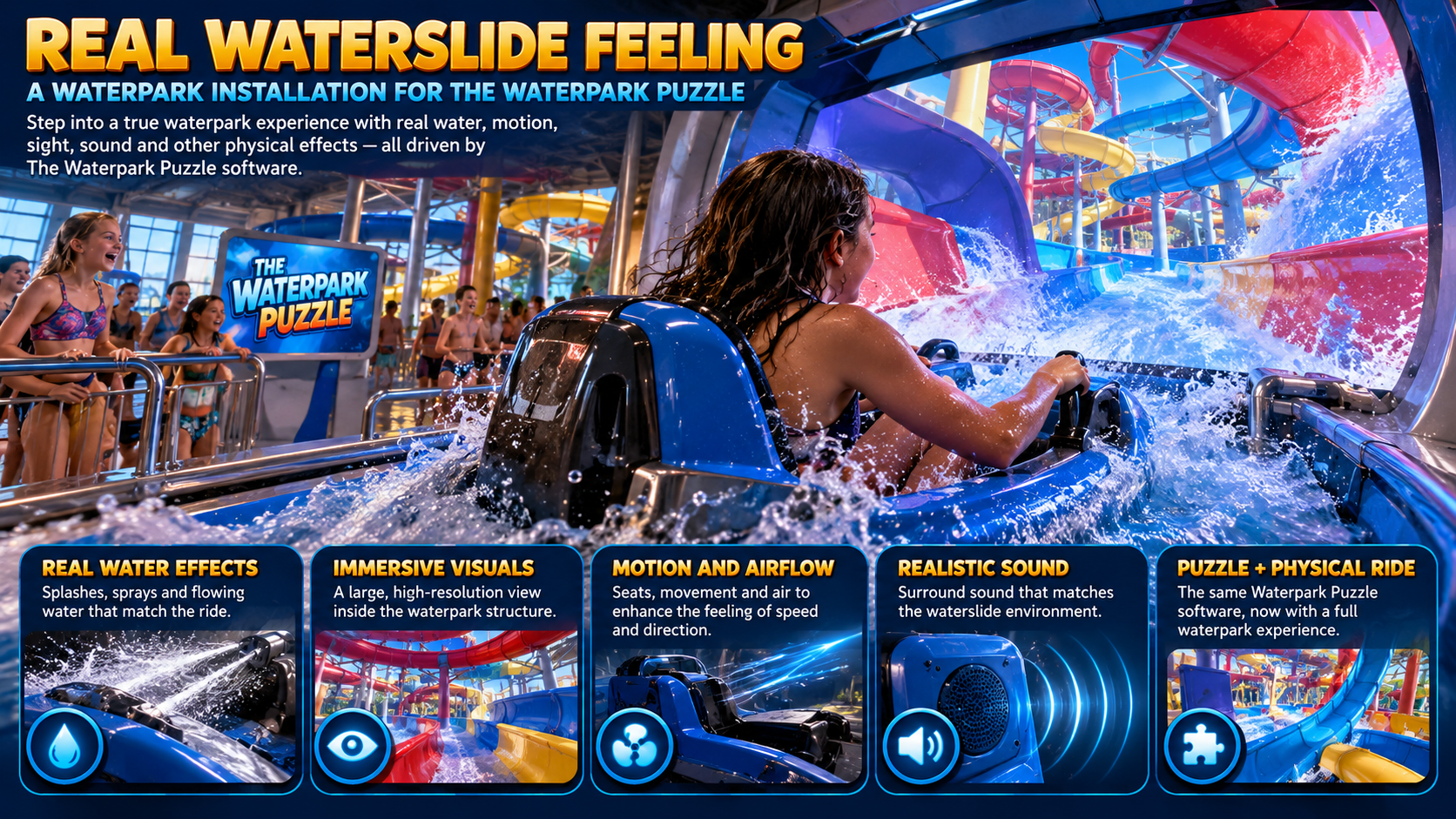
For That Real Waterslide Feeling, We’ve Gotcha
MORE INFORMATION
How the Puzzle Works
The simplest version can begin with two waterslide entrances and two exits. Because most of the route is concealed, the first answer can only be a guess. The ride then supplies evidence. Larger puzzles can introduce more slides, more crossings and longer routes while preserving the same basic idea.
MORE INFORMATION
Learn the building from the inside
The first-person waterslide is not merely a reward animation. An open-top route inside the puzzle building can reveal turns, elevation changes, nearby slide sections and landmarks that help a visitor reconstruct the hidden system. The game can ask for a new answer after each ride or allow the visitor to keep exploring.
MORE INFORMATION
Save Your Progress on a Puzzle and Pick It Up Later
As puzzles become larger, a visitor may need more than one session. The intended feature is specific: save your progress on a puzzle and pick it up later. A returning player could continue from the same observations, routes and unanswered connections rather than starting over.
MORE INFORMATION
Persistence can support longer discovery
Saved progress could work across compatible workstations, cabinets, tablets or phones when accounts, privacy, venue operations and technical design support it. The game should also remain enjoyable for a guest who wants one short session without creating an account.
MORE INFORMATION
Create Your Own Waterpark Puzzles
A creation mode could let visitors design buildings, slide routes, crossings, landmarks and difficulty levels, then share approved puzzles with friends or participating locations. Designing a solvable puzzle can become part game-making, part spatial design and part storytelling.
MORE INFORMATION
From player to designer
Creation tools could range from simple drag-and-drop construction to more advanced geometric, rendering or simulation tools. Publication and cross-location sharing would require clear moderation, attribution, privacy and content rules.
MORE INFORMATION
Dry Interfaces
The same game could run through a dry arcade-style cabinet, dedicated chair, workstation, tablet, phone or other interface. For many family fun centers, these are likely to be the most practical ways to offer The Waterpark Puzzle. See Our Hardware for the physical-interface direction.
MORE INFORMATION
One software experience, several physical forms
Hardware can change session length, comfort, controls, accessibility and spectacle without requiring the puzzle itself to become a different product. A venue could select an interface appropriate to its audience and floor plan.
MORE INFORMATION
Wet Interface — Real Waterslide Feeling
A waterpark could choose a specialized wet installation combining the first-person ride with controlled water or mist, airflow, directional sound, vibration, motion and other carefully designed effects. The aim is a Real Waterslide Feeling while the visitor continues solving the puzzle—not a claim that a chair perfectly recreates every force of an actual waterslide.
MORE INFORMATION
A physical interface that fits a waterpark
Water-resistant housings, drainage, electrical isolation, accessibility, sanitation, supervision and applicable safety requirements would need professional engineering before any real installation. The artwork represents a concept, not an existing certified attraction.
MORE INFORMATION
Connecting the Puzzle to HPC Research
The basic question—where does a hidden slide go?—does not automatically require HPC. The connection becomes more meaningful as the same puzzle family adds demanding rendering, geometric reconstruction, physics, fluid simulation, collision, optimization or very large procedurally generated structures. Visit HPC Research for this computing layer.
MORE INFORMATION
Compare specific tasks rather than asking who is “smarter”
A future benchmark could compare how a person and different computer systems approach particular tasks. Useful measurements might include completion time, hardware or provider, monetary cost and energy/resource information when those figures can be documented responsibly. Measured data, vendor-published data and estimates should always be distinguished.
MORE INFORMATION
Education & Recreation
A visitor does not need to arrive thinking about geometry, engineering or high-performance computing. The experience can simply begin with a fun mystery. For visitors who want to go deeper, the same game can open optional paths into spatial reasoning, architecture, physics, game design and computing.
MORE INFORMATION
Fun first, deeper exploration when wanted
Fun Center HPC’s broader purpose is to let people of all ages encounter unusually capable computers in a fun and safe space. The Waterpark Puzzle can support that purpose without requiring every guest to treat recreation as a lesson.
MORE INFORMATION
Opportunities For Improvement
The concept can evolve through player feedback, operator feedback, accessibility testing, better puzzle-generation tools, improved simulation and new interface ideas. Family fun centers are the primary frame of reference for outreach, while waterparks and theme parks could also choose Education & Recreation computing experiences suited to their own environments.
ART ARCHIVE
Visual Records
No Waterpark Puzzle artwork has been archived yet. The six-part series remains in the active Art Gallery above.